
Teaching Zooarchaeology in the Field with 3D Prints
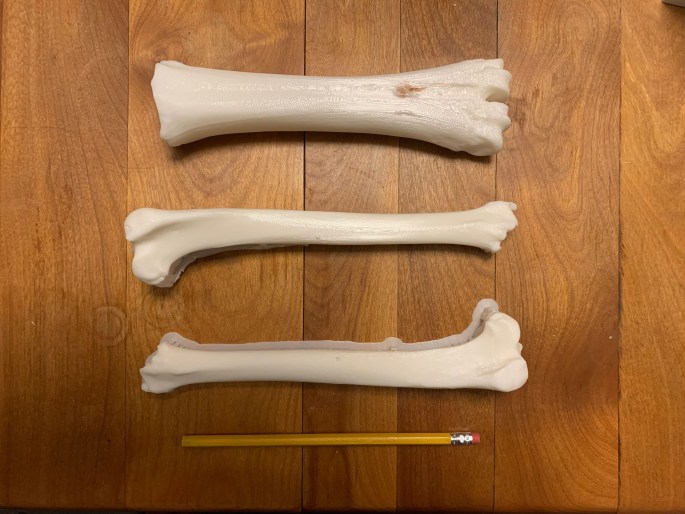
Excavations at Dún Ailinne in the 1960s and 1970s produced one of the largest animal bone assemblages dating to the Iron Age in Ireland. The collection of ~18,000 bone fragments is currently in storage at the National Museum in Dublin. The location in storage and the fragmented and fragile nature of the bones means that access is extremely limited and restricted to research purposes only. While such protective measures are necessary, the restrictions make it difficult for students at the field school to understand and contextualize the highly fragmented (< 2 cm) pieces that we currently are finding. It also presents a challenge when communicating the importance of findings and the site to the public.
I am currently working with the Emerging Technologies(ET) team at OU Libraries to print 2 sets of animal bones for use in teaching and engagement activities at Dún Ailinne. The 3D models were downloaded from the Sketchfab website and consist of those items where the 3D model creator has given permission for the work to be downloaded and used. The samples selected represent those species and bones that are most commonly found at the site (horse, cow, sheep, goat, and pig) and have provided the most understanding of how the site was used and functioned in the past.

Additionally, the ET team has created a program that will allow you to enter in words or phrases and will autogenerate 3D models of the text translated into Braille. We are using the program to generate removal label plaques for each bone to make them accessible to a larger audience.
It is our goal to use these for demonstration, but we are also hoping to build some type of teaching activity that local heritage centers and even schools can use in the future. We plan to continue adding additional prints as they become available.
The current 3D models we are printing are shown below with links to their sketchfab locations. Many thanks to the following organizations for making their models available for use under the creative commons license.
Chair of Anatomy, Histology and Embryology at the Faculty of Veterinary Medicine Munich
Metataursus (foot bones) cow [Munich]
Radius/Ulna (lower arm bones) cow [Ravi Teja]
Femur (thigh bone) sheep [Munich]
Tibia (shin bone) horse [VCL]
Tibia (shin bone) sheep [Munich]
Distal phalanx (toe bone) goat [Munich]
Distal phalanx (toe bone) sheep [Munich]
3rd metacarpal (hand bone) pig [VCL]
Lower 1st molar pig [Munich]
Lower 3rd molar sheep [Munich]
Femur (thigh bone) fragment cow [VCL]
 zenobiewan
This is a fantastic resource! Any thoughts on using these as teaching tools compared to buying modern bones? Obviously hygiene issues–is there a way to make “breakable” models where you could highlight the main kinds of breaks/butchery that you see?
It would be very interesting to see the chaine operatoire of moving from a metatarsal to a bone point, for instance, using these models even if the steps would have to be somewhat simplified.
Excited to see more of this in the future!
LikeLike
These are both excellent questions! So shortly after the first bones were printed I did have a thought about “oh maybe it would have been better to reach out to the local butcher for material” because then it would be more of an exchange than just me going “I have things let me teach you!” Also there is something to consider about real animal bones and sustainability as they will break down over time etc. but having thought about it and maybe trying to figure out if more prints are justified here is where I have landed. They are more hygienic and can tolerate being wiped down between handling a bit better than regular bone. I don’t have anywhere to process bones in the field and having to pad them to fly them over from the states would take up too much room. The prints are also a bit hardier than bones so can be thrown in the boot of a car or crammed in the back of a storage shed without any damage. And it takes off a bit of the extra patrolling of proper handling at open days (though promoting respectful handling is always important!) Those are the practical reasons but it’s also a kind of test because I’m curious how they will be for teaching!
In terms of the breakable models that is something I definitely want to build! I want to have prints of archaeological breaks (we do have one fragment print here) but those are bother harder to find (I don’t know why) and harder to print because of the thin edges. I’d also like to create snap together sections of bones so that you could see for example how long bone shaft shape changes throughout the bone. That requires some additional modeling and I’m totally willing to admit I went fir low hanging fruit in the first go. See what was already out there and then start thinking about what could be made. We should collaborate on that you would have fantastic ideas! I think the chaine operatoire idea would be awesome you’d just have to find bones in those various stages to model. Interestingly there are a good number of models available but when you limit the search to Creative Commons licensing it’s much more restricted. I think people have the right to put whatever license they want on their work but I’m hoping that part of this will make the case to make more models and give them a cc license (even if it’s just making the case to myself that I need to do this!)
Might be cool to make a early domestication set in the near future if you’re interested!
LikeLike
This is such a helpful overview of this process and it’s application to zooarchaeology!
LikeLike
Thanks Smiti!
LikeLiked by 1 person